
Resonant raindrops needle against my nylon tent fly as I awake to a mist enshrouded morning. Having been too lazy last night to erect the full tent, I just threw the fly over myself. I had arrived at this trailhead around midnight, and now I was paying the soggy price for my tired indifference to the climate. My companions, for the most part, are stirring about, stuffing sleeping bags or staring at the steady drizzle.
The first mouthful of dry granola sucks all the spit out of my mouth, cool water restores it as the oat mixture hits my stomach with a heavy, cement thud. Time for my rehearsed bear safety speech, what to do if we see a bear, if it approaches, if it charges, if it starts to gnaw on one of us. Their eyes grow large without pupils as I tell them to protect their heads with interlocked hands. Sufficiently terrified, we shoulder damp, heavy packs and begin the trudge up the steep slopes to the summit of Mount Silcox. A trudge is a fitting descriptor of this trail—or is it trial—one switchback after another for three thousand vertical feet, long enough that each saddle must be the top, only to spy another series of damnable serpentine curves.
At first clearing, the sun breaks through like some picture book about Glacier National Park. The first of uncountable Blue Grouse flushes up through the dry grasses of the south-facing slope, their abundance attesting to the peak of their population cycle. Halfway through the morning, foot and boot have almost become one and the same, having melded under stress like some alloy. A bit of shade offered by a stand of stunted Douglas Fir becomes a temporary diner. Salami and cheese, nothing like a pocketknife slicing through salami and cheese, the perfect fatty lunch, food that scares the hell out of the low-fat crowd. I remind my guests once more that this is bear country and that although the odds are slim, we could see a bear, black probably but a bear nonetheless. Modified, subdued fear crosses their oxygen deprived faces again.
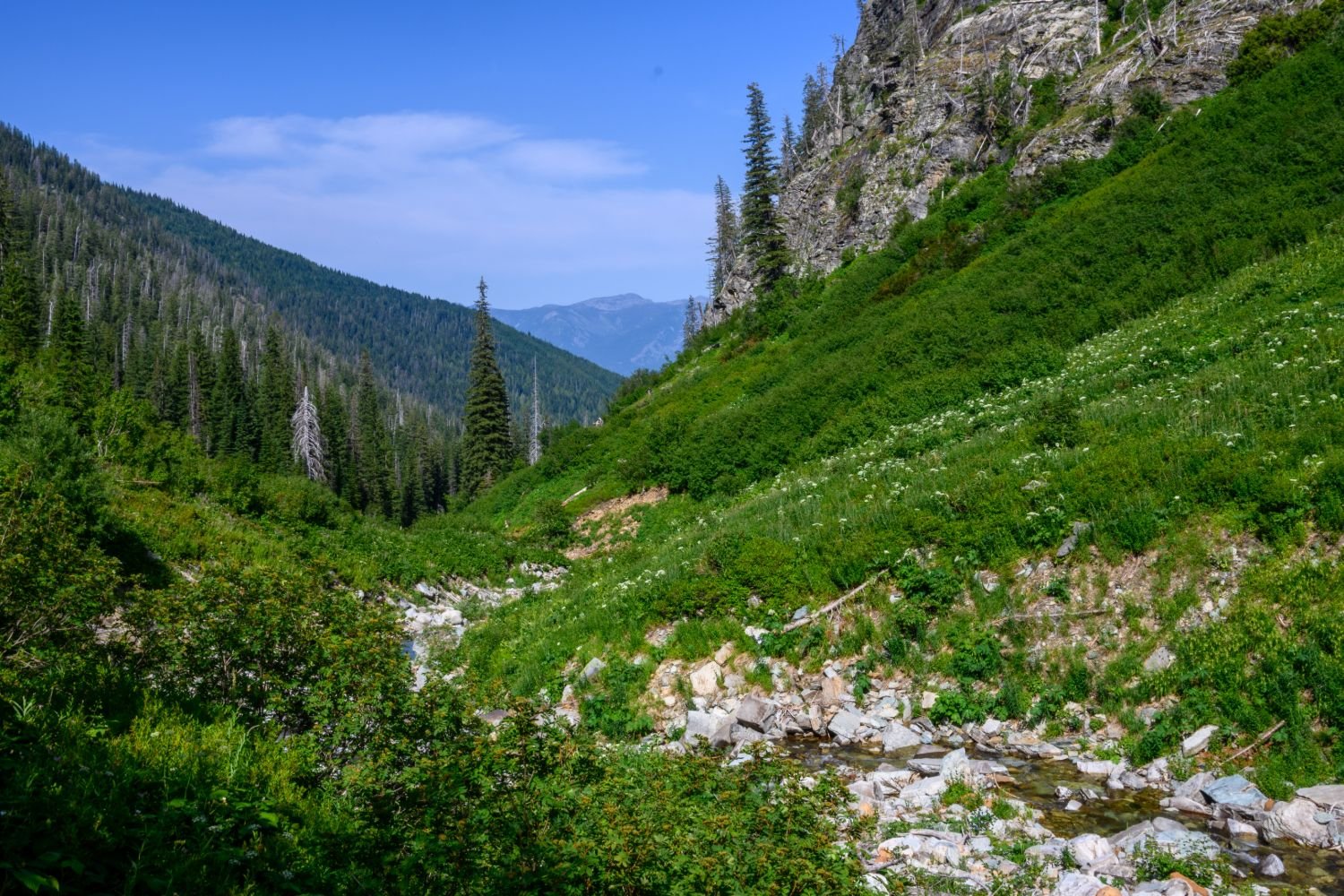
Higher means colder, and the sweat soaked t-shirts now act as refrigeration units drawing heat from our bodies. Entering the final clearing, a vast spread of beargrass and huckleberry bushes, we have firmly entrenched ourselves in bear country. The old foundation of a demolished fire lookout stands as a promontory at the apex of Mount Silcox, the marker of descent to the Goat Lakes and onward into the Four Lakes Basin. From this vantage point, we can follow the sweep of the Cabinet Mountains to the northwest, stretching to the Kootanai River in this corner of Montana. These mountains are not the angular peaks of rock and ice one sees on the cover of adventure magazines; the Cabinets are amazing in other ways. The lush forests of Western Cedar and Hemlock in the lower elevations fade into the subalpine fir at the timberline. It is an area of the Pacific melding with the Rocky Mountains to create an ecosystem not found anywhere else.
Crossing the triangular crest, sore knees ache from the steep downward trail, muddy from the recently melted winter snowpack. Two hundred yards down the path, and we find an unmistakable calling card of a great presence. The front track of a grizzly bear, the claw marks evident in the muddy soil, a reminder of our place here in these mountains. Fascination hovers thick as we each get down on our hands and knees, and study the impression and our feelings about it. The simple existence of this track attests to a struggle and tenacity of a beleaguered group of survivors. The track is a sign of the ghostly existence of the endangered Cabinet-Yaak grizzly.
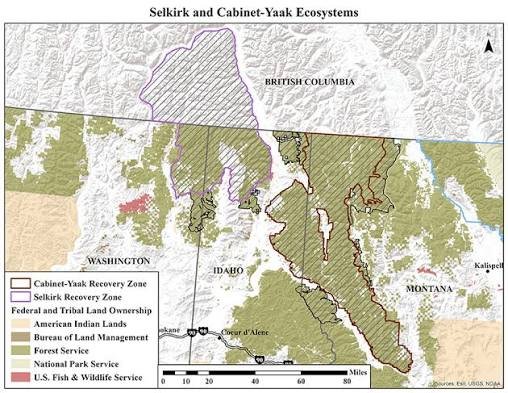
The Selkirk and Cabinet-Yaak recovery zones.
The Cabinet-Yaak grizzly is a specific endangered population of the bears in extreme northwestern Montana that has hovered on the edge of extirpation. They are not the glamour bears of Yellowstone—these bears are largely out of sight and out of mind for most people. Against the odds, however, they hold on in this sliver of wilderness surrounded by extensive clearcuts and small towns. With such a small population, all these bears are important to the continued existence of grizzlies in the Cabinet-Yaak region, but then again some bears are more important than others.
On June 10 of 1998, we all became a little poorer, although most of us never knew it. One element that made our surrounding wilderness wild had ceased to endure, the very essence of freedom was gone. What of such value did we lose? It was a single bear, a solitary being, a female grizzly given the cold identification number of 106. Female 106 had lived a most valued life, to us and to the mountains.
Bear 106’s carcass was found about 15 miles north of Troy in the 17-Mile Creek drainage. Near her largely consumed body were the bodies of her two cubs. Scattered about the gruesome site were the dark colored hairs, which contrasted with her blond pelage, probably, of a male grizzly. The remains of a devoured elk lay close by, the mutual attractant that lured the two bruins to the same place at the same time. Most likely in an effort to defend her progeny from a perceived male threat, 106 became engaged in the final battle of her life. After he had dispatched 106, the male systematically killed the two cubs, a deep-seated response that removed genetic competition with the adult bear and created room for his possible offspring. Bear 106’s death came as naturally as any other for a griz. It was a wild demise not caused by the clumsy hand of man, however, her life had always known a human presence.
She was first captured in the summer of 1986 by a research team charged with gathering information on the few remaining grizzlies that inhabited the Yaak country and Cabinet Mountains. Her movements were tracked by radio collar, the first invasion of her existence and privacy, a victim of technology in the effort to protect and restore the great bear. The area of Roderick, Clark, and Grizzly Mountains in the Yaak were her core home range, the area in which she chose to feast on cutworm moth larvae, the purple gold of huckleberries, and whatever else suited her discriminating fancy. I imagine her turning over large boulders in pursuit of tiny insect grubs, the summer delicacy. As most of us do, she ventured far from home, north into Canada and west to the panhandle of Idaho, only to return home safely to the Yaak.
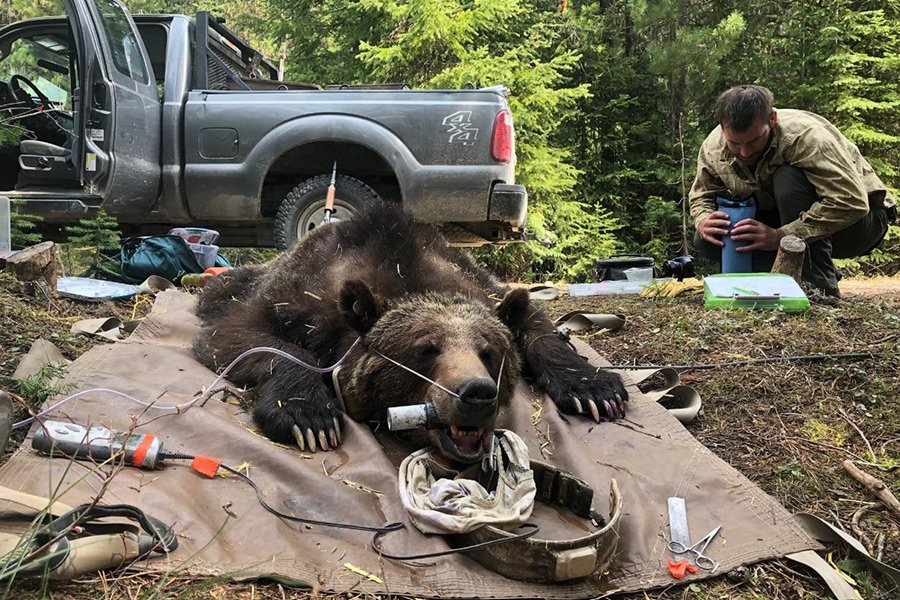
We know that since 1986, Bear 106 had produced 13 cubs, an outstanding reproductive rate for a female grizzly, since most of her kind will only produce two cubs every three years. She had, on several occasions, given birth to litters only 12 months apart from one another. Sadly, we know six of her thirteen cubs to have died, scientists and agency folks can only speculate upon the causes of most of those mortalities. In 1989, another male grizzly killed one of her cubs while 106 was confined in the culvert trap, man’s good intentions resulting in tragedy. One of her later female offspring has gone on to have two litters of cubs since 1994. Bear 106 had three other female offspring that are expected to breed shortly; hopefully her descendants carry her ability for prodigious breeding success. Her biological value to the ecosystem was unquestioned.
Female 106 had always exceeded our numerical expectations of her, for she lived in a fluid, opportunistic world, not one of cold statistics and analysis. She was born, grew, bore offspring, and died in a time crucial to the Cabinet Mountain-Yaak grizzlies. One of a handful of breeding age females (less than ten are known to exist), she belonged to the group that held the hope for the entire population of around 28 bears, the hardy few that chose not to cave in, not to disappear. Low numbers have so stressed the Cabinet Mountain-Yaak grizzly population that the loss of even one breeding female, natural or human caused, is almost insurmountable. The Interagency Grizzly Bear Committee set a recovery goal for the Cabinet Mountain-Yaak grizzly at a minimum population of 106 bears, among other criteria. We are about 75 bears short of that minimum.
Earlier, I spoke of the value of Grizzly Bear 106 as a successful mother, a spreader of genetic diversity in a minute population. This biological significance is, of course, all-important to the managers of the survival of the Cabinet Mountain-Yaak grizzly, however, the greatest value of Bear 106 was beyond numbers and radio telemetry. Bear 106’s greatest value to me was that she made a rugged wild place just that bit wilder. A wilderness devoid of the grizzly is not whole, humans are still supreme, and it is an experience that is incomplete. The mountains are empty. The grizzly should not invoke fear; they are an element of wholeness. The air is crisper and the water clearer, and it is simply wilder. Even if you never visit the Yaak or Cabinet Mountains, the importance of 106 and her kind is that you will always know that there exists a place that is untamed, wild, where man is not top dog.
As a postscript of 106’s legacy, Maggie, her female cub from 1994, denned on Pink Mountain last winter. She was with at least one male last spring. Maggie may have exited her den this year with the new generation of 106’s descendants. Terry, another of her daughters, denned near Sundown Creek in British Columbia. Terry also was seen flirting with a male last spring, so the next generation of Cabinet Mountain-Yaak grizzlies may be lying beneath a warm blanket of winter snow.
Leaving the track behind, we descended down into Goat Lakes. My heart was filled with hope, knowing the survivors were still there, that they continue to exist in man’s overgrown shadow. The Cabinet Mountain-Yaak grizzlies can persist, if we acknowledge their importance and aid them in any way we can, even if that means simply letting them be.